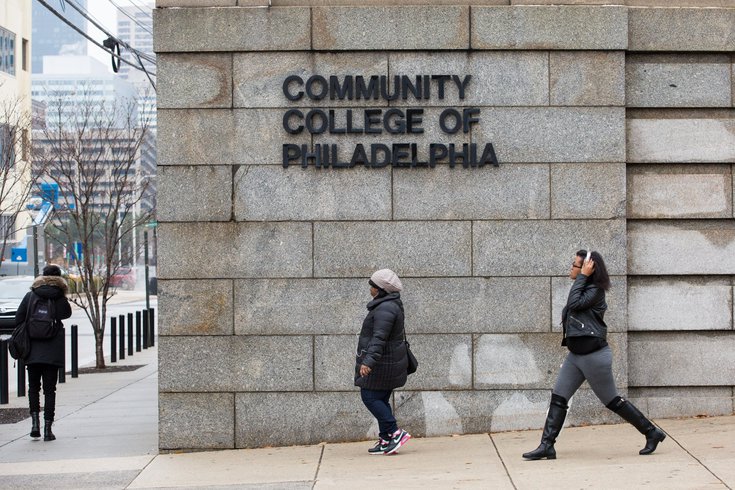
I just retired after over thirty years of teaching at Community College of Philadelphia. The college is what’s called an open admissions institution, accepting anyone with a high school diploma or a GED, and although I’ve taught in various places since the early ‘80s, my time there has encompassed much of my adult life. It’s where I met my husband. It’s also where I matured as a teacher, and probably as a human being, interacting with people I’d never meet anywhere else, learning to watch my words, and struggling not to jump to conclusions. When I served in the Peace Corps years ago, I defined an American this way: we believe that every problem has a solution. Maybe one definition of maturity is understanding that this isn’t always true.
And now, I’ll make an open admission of my own: retiring feels like giving up.
If you heard the news and congratulated me, only to see my face turn stoney, now you know why. I hate this, hate the certainty that when I screwed up, I can’t try again. I can’t redesign a course, or adapt methods, or catch a student after class and say the right thing at the right time. I’ve learned things in my thirty-three years there: I know I have. My mother had a saying: there are no mistakes, only lessons. Can’t I go back and repair everything I’ve broken through the years?
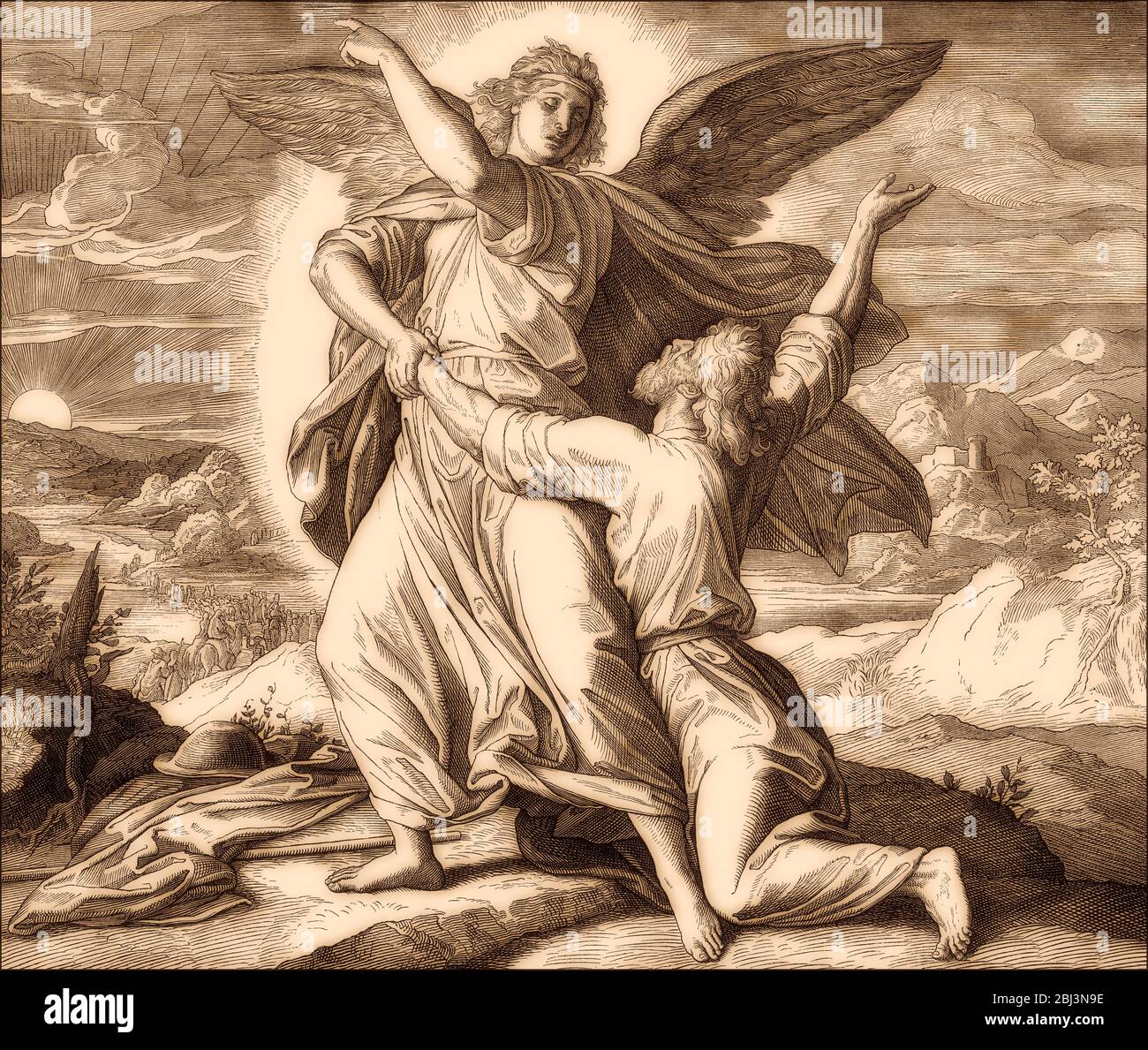
At my college, the possibility for breaking things is endless. The students are true products of Philadelphia: aspirational, tender-hearted, damaged, rough not just around the edges but to the bone. Their innocence of academic conventions often makes their thinking and writing startling and original. I can’t say that I loved grading papers, but oh, how I loved class discussions, and especially meeting with students in my office! Even as I cherished their insights, I saw my job as insisting on logic and coherence, wrestling with that originality the way Jacob wrestled with the Angel, in the process, making that classroom holy ground.
Here is the trouble: I respect my colleagues, ache to learn from them, but since we shut our doors and taught online during the COVID pandemic, I barely saw them, and sometimes they seemed to speak a different language. My students still bring up a visceral response to the point where my intestines are practically pulled out of my throat. What thrilled me, always, was the possibility I felt before each class that I could do better by them, choose the right phrase to write on the board, reword a question, keep track of time, loosen up, affirm, sharpen.
Yet recently, something changed. Students began to lie to me.
Lesson #1: Trust your students
My creative writing students probably didn’t lie to me. The students in my research-paper writing course probably did, but as I see every tiny segment of their process, eventually, I think, they wear themselves down and at least cobble together something like original work. Yet during in Spring 2026, my composition students—at least a third of them—handed in work produced by generative AI for most of the semester.
Trust is honestly the foundation of successful teaching. Students trust professors who are where they say they’ll be, do what they say they’ll do, and (I would argue) admit mistakes and do their best to correct them promptly. That’s the easy part. One thing I loved about my years at the college was the way my policies shaped themselves around promises I could keep. There is real intimacy around this process, as policies gradually reflected what I learned about my students’ crazy, Philadelphia lives.
What’s trickier is this: getting students to believe that you actually do trust them. If students are absent, I don’t want a doctor’s note or, God forbid, an obituary of their father. Missed work, disruptions, late and missing assignments– every teacher has their own way of addressing them, but what teacher in their right mind would insist on documentary evidence that a child had whooping cough, or a car broke down, or a printer wasn’t working, or the student didn’t actually have bus fare to get to school? When they bring this “proof,” I know that at some point, a teacher has demanded it. I will not be that teacher.
Maybe trusting students about these small things will indicate we trust them in deeper ways. In her 1972 essay “Teaching Language in Open Admissions,” the poet Adrienne Rich reflects on her years teaching at Harlem’s City College SEEK program, and considers how she moved from hoping to find a single Shakespeare among her class to holding her students as a whole to high expectations. “This fundamental belief is not a sentimental matter; it is a very demanding matter of realistically conceiving the student where he or she is, and at the same time never losing sight of what he or she can be.” I hope that in my best moments at the college, I managed to communicate this to my students, unsentimentally, sincerely and wholeheartedly.
Really skilled teachers also get students to trust each other: shared drafts, collaborative projects, funny little exercises modeled on reality television, that sort of thing. What I just wrote feels dismissive, but ultimately, when a class of mine becomes an actual community, I feel not like the agent, but an awe-struck observer. Around a year ago, I saw a colleague of mine in the hallway, as his students were inside, collaborating on a paragraph on the Smartboard. He said (with a sly grin) that they’d “kicked him out”.
These collaborations have been proposed as a response to AI, and ability to trust students is most challenged by violations of what is called academic integrity. When I first began to teach, plagiarism was pretty easy to catch, and then came on-line cutting and pasting, which led to plagiarism checkers like Turnitin, and most recently a noxious platform called Copyleaks which scans the internet for “similarity”, and has (of course) a truly stupid AI-checker. Speaking of wasted time, many of my colleagues confirm Copyleaks’s AI score by using at least two other checkers. We’re told to turn these “gotcha” moments into “teaching opportunities”, but what do students learn other than humiliation?
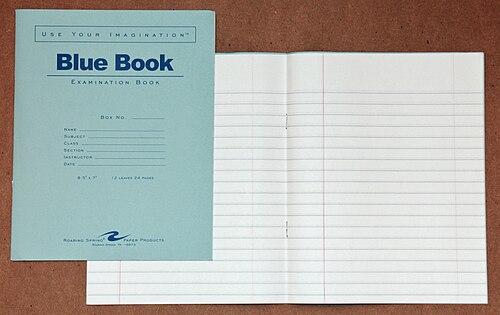
An almost universal safeguard against student use of AI has been to have them do all of their writing in class. I’m a big advocate of students sitting at their desks and pushing their pens across paper, but shaping those meandering, informal thought-experiments into academic essays takes time, space, reconsideration. Having that work drafted in class, re-written in class, and so on, simply to make sure they aren’t written by Chat GPT isn’t pedagogy; it’s surveillance. As for collaborative writing, I honor the collectivist intention, but haven’t figured out a way to make it more than a parlor game. I know some instructors also require students to orally defend their work, which is an interesting exercise, but it’s an exercise in public speaking. When I considered ways I would respond to AI, I told myself that I would only change my methods in ways that made me a better teacher.
So went the past year. I let go of AI-checkers altogether. My composition students turned in everything on paper, and I encouraged them to write by hand. I wrote a lot of comments—even on the daily in-class scribbles that I called check-ins. When they submitted each essay, every part of the process was submitted too— check-ins, outlines, multiple drafts, all marked with my blue pen, and the revised result, along with a metacognitive reflection on what changed along the way. I even gave them a clip to hold everything together.
Some students did appreciate all of that work on paper, even my handwritten comments, and they told me so. However, at some point, when I looked over the outlines and drafts and revised essay, and read about events that didn’t actually happen, saw quotations that didn’t exist on the page the student cited, or anywhere in the book, and even (in one case), noticed a phrase in a typed paper that read, “based on the information you gave me”, it was clear that students were playing me for a sucker.
Then, I did something unspeakable: I actually retyped a student’s handwritten assignment into Copyleaks, Integrity, and GPT Zero to confirm what I suspected, and that was the moment when I knew something was broken.
Trust does imply a kind of covenant; you trust me, and in turn, I trust you. And yes, that covenant was broken. Yet I actually meant that something broke in me. There must be a way forward, but unless I could change my idea of what reading and writing was, I couldn’t go there. In short, my own ethical and pedagogical parameters could not adapt to whatever came next.
Rule #2: Don’t back yourself into a corner.
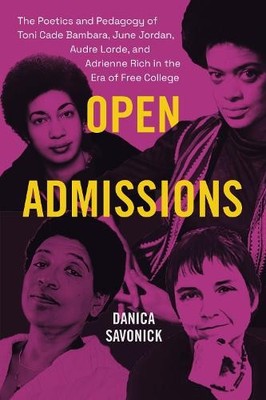
Years ago, I recommended Adrienne Rich’s essay about teaching to a colleague, and when I retired, he gave me a book about the whole SEEK program. The book is, of course, called Open Admissions. That title is clearly irresistable; my colleague Ned Bachus used it for his 2017 memoir. However, this one focuses on four SEEK instructors: including not only Rich, but Toni Cade Bambara, June Jordon, and Audre Lorde. The program came out of a 1964 protest led by Shirley Chisholm to broaden access to this tuition-free institution. The author, Danica Savonick, uses archival material to present each woman’s teaching methods, and pedagogies of liberation: affirming, personal, and radically student-centered.
Savonick records how in the classes of those cultural superstars, students very much like my own select material, determine methods, and in some cases, even decide how they will be graded. In at least two cases, an early assignment is this: design a course you want to take this semester. Then, they take that course. Bambara’s students explore a problem that needs a solution, do fieldwork like anthropologists, and report back through “skills-sharing”. Jordan gathers their work into anthologies that become teaching texts. Lorde’s students discover how verb tenses make them masters of time. Their students write scripts, design housing, examine their own breasts (this is Rich), and are fully engaged with the political life of the city. It feels ironic, reading all of this just as I am no longer able to apply it to my own classroom.
Yet, although the book is called Open Admissions, not much here is actually admitted. It is essentially hagiography. We don’t hear about students who drop away, who flame out, who wander off during fieldwork and just have no idea how to get back again. We don’t know about their struggles with language, their frustrations, or even if their agency in the classrooms translated to agency on the page. Sure, affirmation and empowerment are necessary elements of teaching, but are they ends in themselves? Of course, this is not a rhetorical question, but at some point, I decided that the greatest gift I could give my students was structure. The rest of their lives may be chaotic. My classroom would not be. Their opinions matter; their voices matter; all will be heard in the context of a semester I would plan. They would work on reading and writing, step by step, and yes, it would be hard work, but it would lead somewhere powerful.
At the same time, I may be dead wrong. Writing—I can hear the four SEEK women say —is only one form of communication the way that reading is only one way to gain knowledge. Why privilege the written word? Why not open your mind to countless other ways students choose to dig and to construct? Value the shape that learning and teaching takes, and watch students own the process. I shudder to consider what they’d say about my earlier metaphor of Jacob wrestling that Angel. My choice of words implies paternalism, not to mention a kind of violent domination of student imaginations. Last spring, a talented and headstrong student demanded to know why an academic essay had to show connections between ideas. I did my best to explain She told me that I was treating the class like children. She would not elaborate.
Still, almost without exception, our students believe that the best way to challenge authority is to understand its rules. In fact, returning to that ill-chosen metaphor, my students want to be both Jacob and the Angel; they want to be the ones who will wrestle with their own imaginations, and, just as after that battle, Jacob took on the name Israel, wrestling will transform them into someone new. My role is this: I show them how to wrestle. One student, formerly incarcerated, told me that what he learned in my class helped him to write up briefs asserting his innocence. Even in creative writing classes, my exercises push students towards understanding limited point of view, or the function of dialogue, in ways that may lead them to subvert those conventions. I will defend the beautiful, soaring, strictly scaffolded cathedrals of my classes, even as I rebuild them every year. Yes, those classes are cathedrals, soaring up from a foundation all the way to (here, I feel frankly embarrassed) heaven.
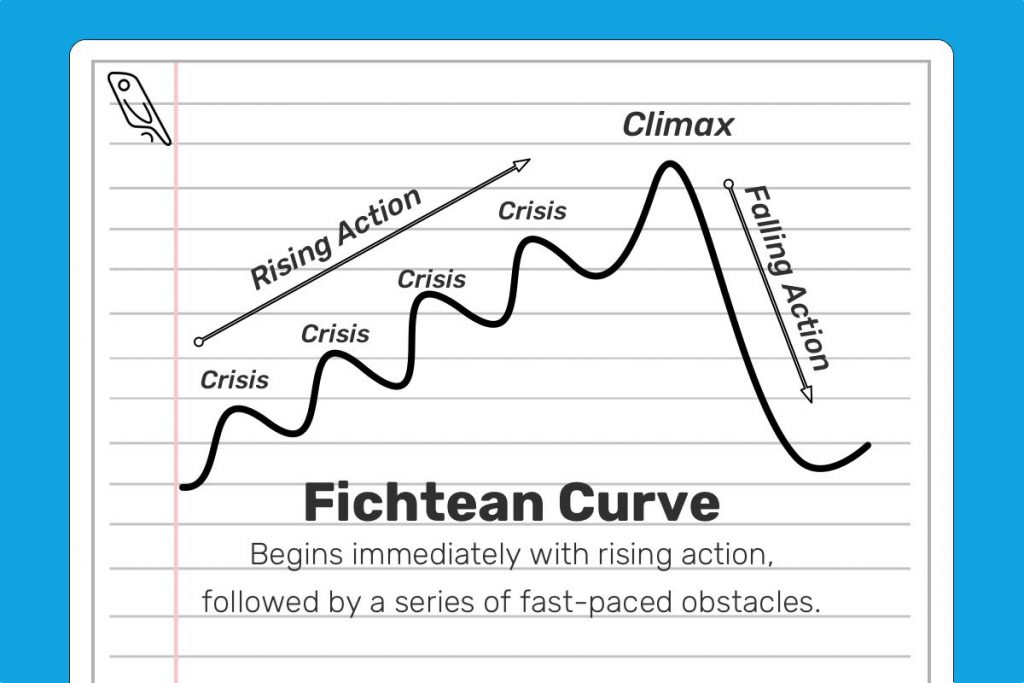
No, maybe a better word for the structure I create is “narrative”. Each semester has a dramatic arc, what my creative writing students know as the Fichtean Curve. At the start, a central character (aka a student) faces a dramatic question. Then, the student confronts a series of obstacles, essays increasing in length and complexity. The last essay is the climax where that dramatic question is resolved, followed by a denouement. In my last years at Community College of Philadelphia, the primary vehicle for this narrative arc was Octavia Butler’s novel, The Parable of the Sower. There, the question might be: how do you survive in a dystopia? The novel was complex, problematic, and usually irresistible to students. Yes, it worked and worked.
Until it didn’t. The process was probably gradual. Maybe I’d taught the book too often, or maybe other factors kept the group from being fully present, but, again, AI played its part. The success of a class like mine is cumulative, and when notes on reading are Chat GPT-generated and hand-written into the margins of the novel, or when we can not dig into open questions because students are afraid to get them wrong, it’s impossible to move forward. I should have let go of my gorgeous sequence of assignments, of course, but what would I replace it with: oral reports? collaborative fieldwork? Should I have asked students what sort of class they’d hoped that this would be? Perhaps that would have been the best response.
Here is a telling detail: another adaptation I had made to the course was an extra-credit opportunity. I gave those students a chance to teach the class a survival skill. I gave examples: basic first aid, say, or how to cook rice, or how to know whether you trust someone, or how to save money. I passed around a sign-up sheet. I am almost certain that if I’d given students this chance pre-Covid, half of them would have volunteered. Now, in the fall, maybe five people signed up, and only three presented. In the spring, it was down to two students. One taught the class how to budget money. The other was seventy years old, a frail, wide-eyed lady who had signed up to present the skill of “knowledge.” She told the class the story of her life. Then, I hugged her.
I loved that student. She was absolutely fearless. I cannot tell you how many drafts I saw of her work, and how many times she came to my office, dragging a wheeled suitcase of her belongings behind her. This was her third time taking the course, and she threw her whole self into it, writing and writing, reading and reading, and I will make another open admission: she earned a D, and reader, I gave her a C which will allow her to retain her financial aid and take the research- paper class next fall.
Most of my Spring 2026 final grades were generous. I suspected that I was off my game, and didn’t do right by the composition students in particular. As I reflect on the dynamics of that classroom, slowly, I realize this: students weren’t using AI because they were playing me for a sucker. They weren’t violating academic integrity because they found the work of the class meaningless. I wasn’t treating them like children either. This new post-Covid generation of students use AI because they are terrified. I may trust them; they may trust me. They do not trust themselves.
Lesson #3: Assign a Final Project
I’m sure I’m right; those students do not trust themselves. Certainly, sociologists and other cultural critics have written about the way the past decade has stripped away a sense of human agency. I can only speak from my perspective as a teacher. I’d like to blame the Covid-19 epidemic, where for two years, there was no classroom that could become holy ground, but Covid and its consequent alienation simply accelerated a process that began years before. I’d love to blame AI, but it feels blazingly clear that AI isn’t the cause; it’s an outcome. I’ll name the cause: they have no privacy.
For these students, there is no such thing as a private space. For example, increasingly, trouble, in one form or another, finds them everywhere. Of course, I’m talking about phones. Wellness gurus urge us all to take screen-vacations, but to people like my students, this is a luxury. They are, more often than not, the most responsible members of an extended family, expected to care for other a neighbor’s children, assist disabled grandparents, rescue a friend whose car breaks down. Phones bring all of that into a classroom. Years ago, I banned those phones. Then, SEEK-like, I asked students to create a class phone policy that they could enforce collectively. As you can imagine, the resulting policy was pretty feeble. Trouble crashes through the walls, problem after problem they are expected to solve. Their phones tell them that solutions to those problems are at hand, and they usually take the form of yet more technology, as they scroll through social media, videos and newsfeeds for an answer.
Technology as problem-solver is now built into Education Reform, a movement that instructors like Bambara, Jordan, Rich and Lorde could have imagined (they imagine everything), but would bitterly opposed. Online platforms produce streams of assessment data that shape curricula that shape what we’re expected to teach. Before the Covid epidemic, most instructors at our college only used online platforms if they were teaching online courses. Now, almost everyone uses them, including—another open admission— me. Even when I insisted that student work must be submitted on paper rather than on those platforms, I posted grades on there because students had grown to expect it. Posting online also automatically averages grades in ways that present an illusion of objectivity. In short, it made my own life easier. Yet in spite of what administrators tell us, the information in those platforms is NOT private, and feeds the Leviathan of Course and Program Assessment, the sea-monster that has swallowed much of our energy as teachers. As for students themselves, they tie their fate to numbers that appear, breathlessly watching decimals rise and fall in ways that have nothing to do with what happens in the classroom.
Note a pattern here: the technology that makes life easier also becomes a way to pretend we are not responsible for our actions. Enter AI. Those same educational reformers are pushing AI in a big way. Without consulting faculty, our administration purchases AI platforms for students, and holds professional development sessions on ways AI can simplify the lives of professors. Use AI to develop student-friendly syllabi. Let AI design power-points, write discussion questions, and craft exams. Don’t use AI to grade student work; that’s a line we’re not supposed to cross. However, if AI writes an exam, why shouldn’t AI grade that exam too? After all, we may—God forbid—make a mistake!
In a world without privacy, mistakes cannot be turned into lessons. Who has the time? Last year, I took a break from Parable of the Sower and taught Orwell’s Nineteen Eighty-four with decidedly mixed results. I think it was too close to lived experience. Like the citizens of the novel’s Oceania, every moment in our students’ lives is spoken for, and during the novel’s key discussion between Winson and O’Brien about whether Winston should believe the evidence of his own eyes, most of them took O’Brien’s side: there aren’t facts, only perceptions. Direct experience– facts that can be seen, smelled, touched, heard, tasted—can not be trusted. Much as Chat GPT harvests and repurposes human language into facile and articulate fabrications , the Party in Nineteen Eighty-four harvests what it gathers from telescreens, and replaces the messy reality of what people experience with the illusion of collective harmony. If the Party hallucinates, who notices? Why would it even matter? Yet what we see with our own eyes does matter in ways that standard academic discourse cannot always honor. In Open Admissions, Savonick quotes June Jordan’s description of her aim as a teacher: “’enablement’ […] the encouragement of Black children to trust and then to express their own response to things’”.
But I digress: I meant to talk about a way out of this terrible conundrum. I want to talk about Final Projects, what they are, how they function, and, maybe, how I did discover and use one pedagogical tool that would generate approval by the four women who taught in the SEEK program.
When I began to teach Parable of the Sower, the novel was a vehicle for close reading, accurate quotation, and analysis, and I pushed students to write coherent, logical academic essays, but as anyone who has read the novel knows, it’s actually awfully incoherent, full of loose ends, contradictions, and emotional outrage. It takes the form of a journal written by a teenaged girl who invents her own religion. Its characters do and say confusing things that defy logic. I taught my students the word “paradox”, but elements of the story aren’t paradoxical. They’re just weird. At some point, I knew that Parable of the Sower demands a response that is NOT academic.
Thus, in the last two weeks of the semester, my students “respond” to the novel in just that way: art, music, poetry, something I never could have imagined. Sure, I require a short statement explaining a connection to the novel, but from there, the field is open. As long as they submit the required statement, and what they produce is in a sharable form uploaded to our online platform, the Final Project will get full credit. Yes, I do give an in-class final exam as well, but that feels like a formal and official ending, like a period at the end of a sentence. The project is more like an ellipsis, a … that indicates what students carry into the future.
When students agree to share their final projects with the public, I post them in a Google doc, and here they are:
https://drive.google.com/drive/folders/1v8oJK8Vi-OcTphlBjYeYozMx6Z5Ic5UX?usp=sharing
Look around, and you’ll find invented religions, comics, dioramas, songs, a dance or two, lots and lots of visual art, videos, and yes, some words: poetry, alternative endings for the novel, and even a few personal essays. It’s a jumble, and one of my favorite moments in the semester is when I share past projects with a current class. Those shared projects generate excitement, and it’s earned excitement. Unless students had read Parable of the Sower, really read it, what they saw on Google Doc would be meaningless. Now they would add visions of their own.
I am not sure a final project would work in every class for every teacher, but as I look back on my years at the college, I wonder if I could have consistently assigned one. I will insist that, yes, it needs to come at the semester’s end, after the reading and writing are behind us. I will also insist that students have an opportunity to make that project public. Given what I wrote about surveillance and fear, this insistence on public sharing may be a paradox, yet it feels critically important. I can only put it this way: when students submit these projects, they are showing me their hearts, and in turn, I just as I need to end one semester, and begin another, I need to honor them by giving that gift away.
A year ago, when I taught Nineteen Eighty-four, I had a student who gave every appearance of engagement and diligence, and who consistently turned in work written by AI. This work was neatly hand-printed, as were her very strange, off-topic marginal annotations which appeared to come from random pages in the novel. I worked hard with her, and by the semester’s end, the annotations did somewhat reflect what was on the sctual page, but I felt genuine despair. I assigned a Final Project that semester as well, and had no idea what she would produce, but was certain that it would be AI-generated.
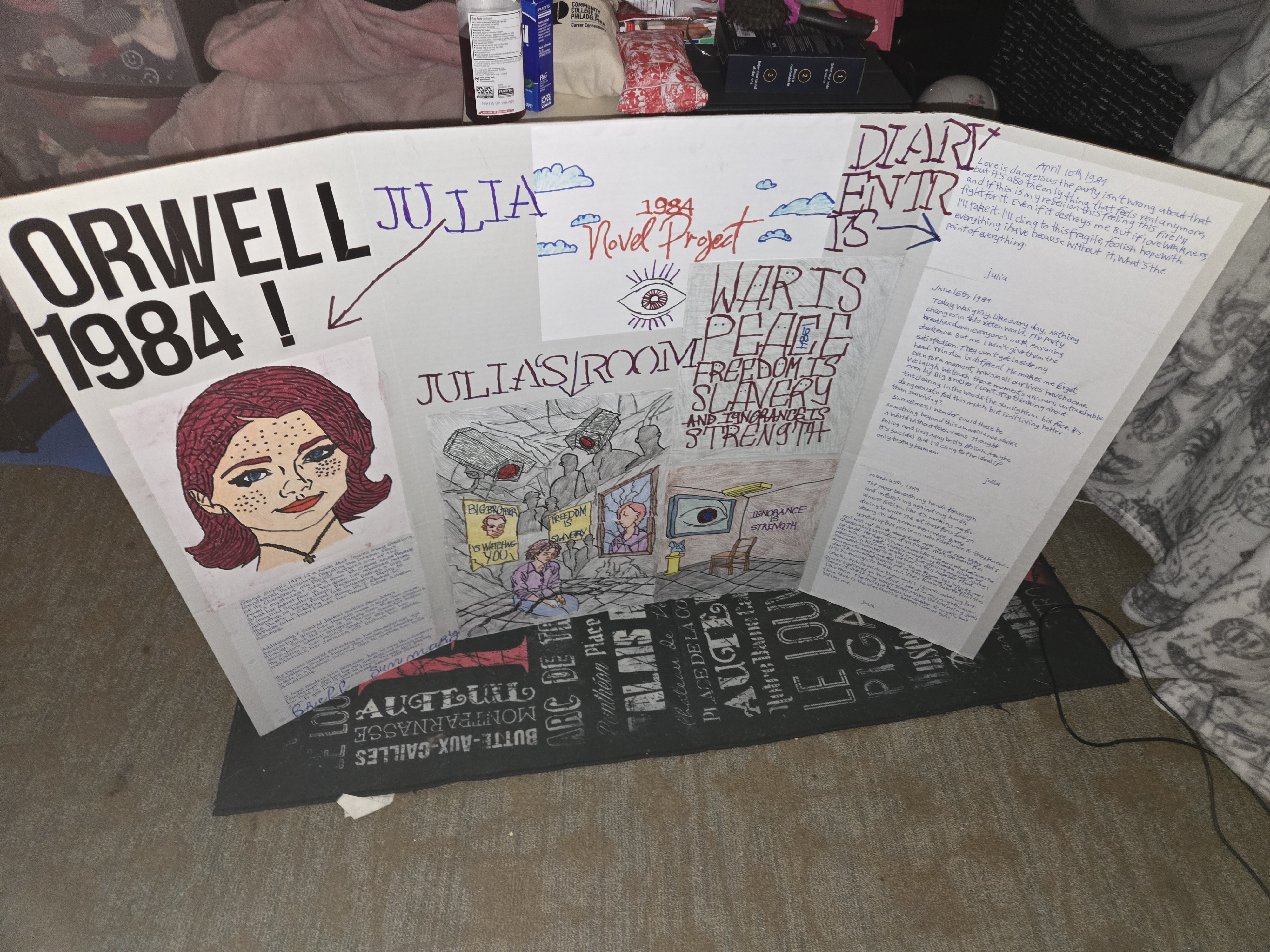
Then, that student brought the result to my office, an absolutely stunning triptych of the novel’s character Julia in prison. The drawing was an accurate portrayal of the Julia in the novel, even down to her black hair and freckles. On another panel, she drew her cell in the Ministry of Love, on the third, some entries from her diary. She must have spent days on this project, pouring every ounce of creativity and discipline into its construction. Yes, she’d read the novel. Why she’d depended so heavily on Chat GPT, I’ll never know, nor can I know if she will ever stop using AI in academic settings. However, the project brought out something that could not find its way anywhere else. When I retired, I put it on display in a heavily trafficked hallway next to our Book Exchange. I hope it’s still there.
Here is my final open admission:
I didn’t assign a Final Project to my composition class last spring. Because of several blizzards, we lost a week and a half of class, and by the time they’d turned in their most complicated and ambitious essay, I knew they were exhausted. There would be no time to prepare them for a final exam, the two-hour essay in a bluebook. I wouldn’t miss it. The Final Project was still on the course calendar. Then, I considered what I knew about those students, the way maybe three of them spoke during class discussions, how more and more of them had started to come late, or not at all, the times I divided them into groups to talk about the novel, and watched them lapse into scrolling on their phones. I thought: how can they respond to a book they haven’t read?
Well, I did introduce the idea, offering it as an extra-credit opportunity; I showed past projects, and their interest was mostly tepid, One student did submit what he called a “personal essay” through our online platform which was identified as one hundred percent AI. What if I had required the Final Project? Would the results have surprised me? The seventy-year-old did submit a drawing, but could never upload an image I could share. I wish I’d shared it, wish I’d seen one from all of those problematic, terrorized, sad students. Most of all, I would have loved them to have seen each other’s.
Is this reflection an apology to those students? Perhaps it is, and I may well find a way to send it to them through the remnants of the college’s online platform. It is, after all, my own Final Project, a way to carry my lessons and mistakes into an imagined future, and maybe to let go of them at last. Yes, retirement is just that; letting go. Having come this far in my lessons and mistakes, I have learned this: letting go is not the same thing as giving up. It’s an indication that someone will carry on; it implies faith in the future.
During my last semester at the college, a new colleague asked me to observe her composition class. This is a departmental responsibility I’ve always been happy to fulfill. My curiosity about what other teachers do in the classroom is boundless, and in this case, I knew the colleague well; we often discussed our classes in a format I invented many years ago called a Teaching Circle. I showed up to that class on time; most of the students weren’t there. Slowly, they filtered in. She didn’t take roll. In fact, throughout the class, most of the conventions required by assessors and other bean-counters weren’t apparent. Let students come when they will; they were clearly welcome.
After a review of earlier material, she indicated a pile of ‘zines on her desk: big, small, folded, bound, radial, literary, homemade and professional. Students went up to choose some, and they shared basic observations about their qualities. That’s when she told them their next assignment: they would create their own ‘zines. The contents of that ‘zine would be what she called a “mini-research paper” including two references, one of which would be an interview– aka fieldwork. What strikes me now is this: There was no stupid, binary of academic discourse versus creative freedom. No one was backed into a corner, not the teacher, not the class. I have no idea how this will be assessed, but that’s her business, not mine, thank God.
Go forth, new colleagues. The three lessons that I listed in this piece still hold, but you will take them in directions I cannot take them. If you seem to speak a different language, it may well be the language of the future. You won’t fear AI, or shape your pedagogy around avoiding AI. I can only hope that your students will find AI beside the point because they trust themselves. Along the way, you may even redefine reading and writing, the way that the women in Savonick’s Open Admissions tried to do. I may not approve of the results, but that is no longer my business.
Besides: my handwriting has deteriorated, I need to take off my glasses to read essays, and sometimes, I can’t hear the students in the back row. Sorry about that. Please keep in touch.
 Simone Zelitch
Leave a comment